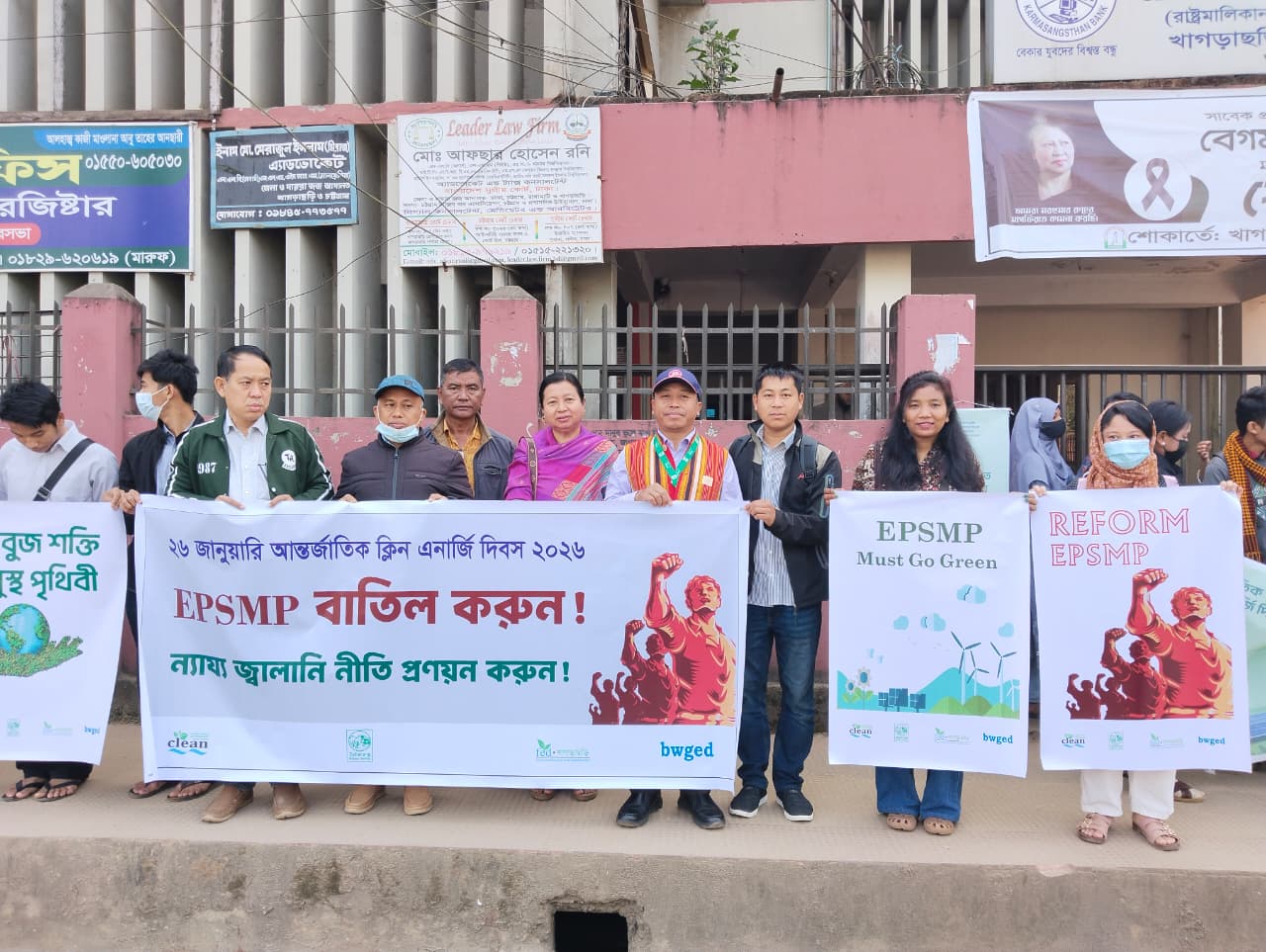
Human chain in Khagrachhari on Clean Energy Day, demanding the cancellation of EPSMP 2025
Ignoring the opinions of the public and experts, the government’s plan to move forward with the 25-year energy and power master plan (Integrated Power and Energy System Master Plan—IPESMP) 2025 has been protested by civil society in Khagrachhari.
On the occasion of Clean Energy Day, a human chain was organized on Monday (26 January) in front of Khagrachhari Press Club, with the participation of the Conscious Citizens Committee (SONAK) and various local NGOs.
Speakers at the human chain said that if the proposed IPESMP 2025 is implemented, Bangladesh’s carbon emissions will reach nearly 186.3 million tons by 2050. This could have severe negative impacts on the environment, climate, and national economy.
Binodan Tripura, Program Director of Zabarang Kalyan Samity, spoke at the event. He said, “Although the master plan mentions renewable energy, there is no effective guideline to reduce dependence on fossil fuels in practice. Instead, it proposes meeting nearly 50% of the country’s total energy demand in 2050 through LNG, coal, and oil.” He further noted that costly and experimental technologies such as hydrogen and Carbon Capture and Storage (CCS) have been prioritized, which could put the country at risk of new debts and subsidies.
The human chain saw participation from Bangladesh Environment and Development Action Coalition (BWEDC), Zabarang Kalyan Samiti, and Clean Environment and Development Forum Khagrachhari. Speakers highlighted four main demands of the nationwide ongoing movement: the immediate cancellation of IPESMP 2025, initiation of a transparent and inclusive national consultation process, formulation of a realistic roadmap based entirely on renewable energy, and ensuring an environmentally friendly and just energy transition.
Binodan Tripura stated that the proposed master plan is completely contradictory to the “Three Zeros Vision”—zero poverty, zero unemployment, and zero carbon—announced by the chief advisor, Professor Dr. Muhammad Yunus. From the human chain, he called on the government to reconsider this master plan with public participation and to formulate a sustainable and environmentally friendly energy policy.
Speakers at the human chain included Zahirul Alam, Vice President of the Press Club, Bela Rani Das, President of the Conscious Citizens Committee (SONAK) Khagrachhari, among others. They emphasized that it is now time to take effective action to protect the environment, reduce carbon emissions, and ensure the use of renewable energy.
