ST-NRM
Project Image
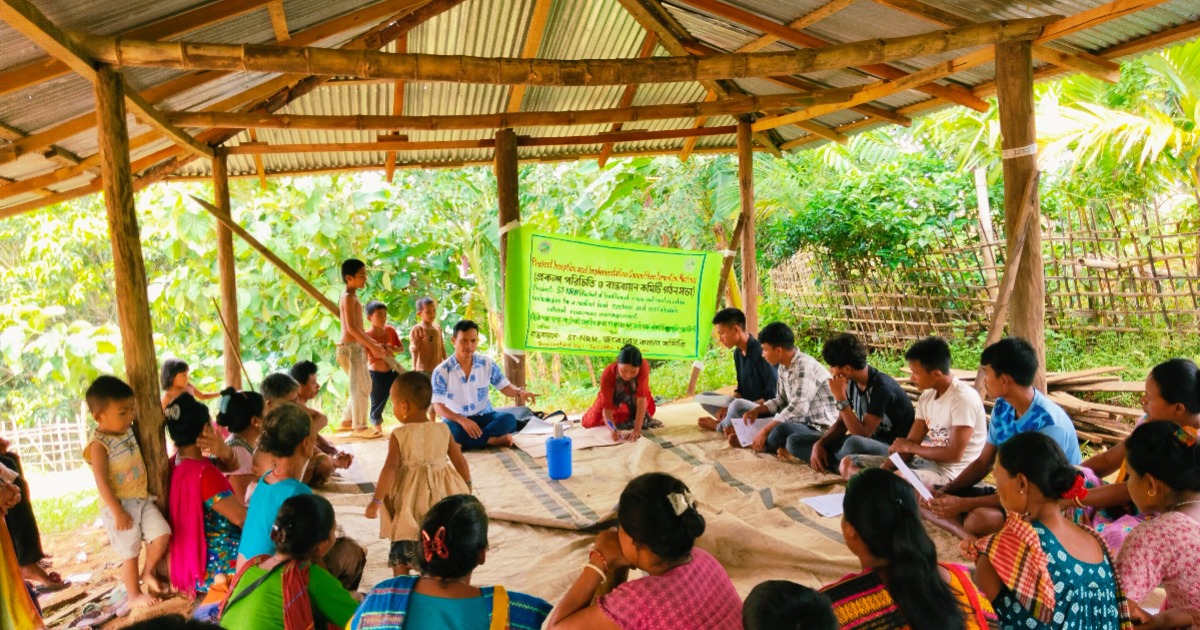
About This Project
Output 1:
Restore indigenous crops by expanding traditional knowledge and ecological farming practices.
Activities:
- Support for jhum cultivation and seasonal farming on fallow land: provide agricultural technology support to 120 families for jhum and seasonal crop cultivation.
- Support 60 marginal farmers in planting, cultivating, and increasing production of indigenous herbal seedlings to enhance traditional/local crops, neglected and underutilized species (NUS), and medicinal plants.
- Conduct intergenerational dialogues on traditional knowledge related to food systems.
- Establish linkages/consultation meetings with the Department of Agriculture to receive social safety schemes, subsidies for jhum cultivation, seeds, fertilizers, and other support and advice.
- Provide training to 12 selected families on making and using Tricho-compost fertilizer.
- Assist 12 selected families in establishing demonstration plots for Tricho-compost fertilizer.
- Document endangered food crops, wild edible species, and existing (but nearly forgotten) alternative pest-control practices.
- Community-based youth engagement in project implementation.
Output 2:
Increase access of marginal farmers to technical services related to agroforestry cultivation from relevant government line departments.
Activities:
- Establish linkages/meetings with the Forest Department to receive subsidies for eco-friendly tree planting along streams/rivers and to access social safety schemes.
- Support 42 selected families from 6 project villages to develop agroforestry systems.
- Conduct research on the economic value of environmental services (PES), print, and distribute findings.
Output 3:
Enhance awareness of local leaders in the project area on gender equality, women’s rights, and climate change.
Activities:
- Provide 2-day community-level training on development rights, women’s rights to resources, and strengthening adaptive capacity to climate change.
- Conduct 2-day community-level training on local and national legal frameworks and opportunities related to climate change and biodiversity.
- Provide 2-day community-level training on gender equality and gender mainstreaming for local elected representatives, traditional leaders, youth, and women leaders.
- Conduct day-long training on participatory monitoring, evaluation, and learning (PMEL).
- Organize meetings and dialogues with networks working on forests, environment, climate change, and biodiversity to address emerging issues in the Chittagong Hill Tracts.
Other Activities:
- Observance of special days
(22 March – World Water Day, 22 April – Earth Day, 5 June – World Environment Day, 15 October – Rural Women’s Day) - Planning & development: preparation of project implementation guidelines and strategy papers
- Monitoring & learning: organize experience-sharing visits among members of project implementation committees in the project area
- Publication of annual reports/newsletters
- Baseline survey
Project Objectives
Objectives
Goal:
Enhanced food security, improved nutrition, and strengthened resilience for adaptation to climate change in the project area.
Objective:
Through sustainable management in the project area, ensure food security and nutrition for local communities and strengthen sustainable food systems and climate change adaptation processes.
Project Progress
Overall Progress
Project Timeline
Project Started
Jun 1, 2024Official project start date
Project Created
Nov 14, 2025Project was created and added to the system
Planned Completion
May 31, 2026Target completion date for this project
25% Progress Milestone
Oct 1, 2026Project reached the first quarter milestone
50% Progress Milestone
Oct 1, 2026Project reached the halfway point
75% Progress Milestone
Oct 1, 2026Project is nearing completion
Project Team

-1763617441.jpg)


![Chittagong Hill Tracts Poverty and Social Analysis Survey [PSA-CHT]](https://zabarangbd.org/storage/projects/thumbnails/image-2-(1)-1763616690.png)